

One Day Hands-On Course with drg. Eddy, PhD at M3i Dental
Theory in textbooks may seem straightforward.
A patient comes in with a complaint, the dentist takes the patient’s history, establishes a diagnosis, and then determines the appropriate treatment.
However, once you are actually sitting face-to-face with a patient in the clinic, the situation can be very different.
The questions asked during anamnesis may need to be more detailed. A diagnosis that initially seems obvious may turn out to have several possible explanations. Then there are other considerations, such as selecting the appropriate medication, isolating the working area, and choosing the right restorative technique.
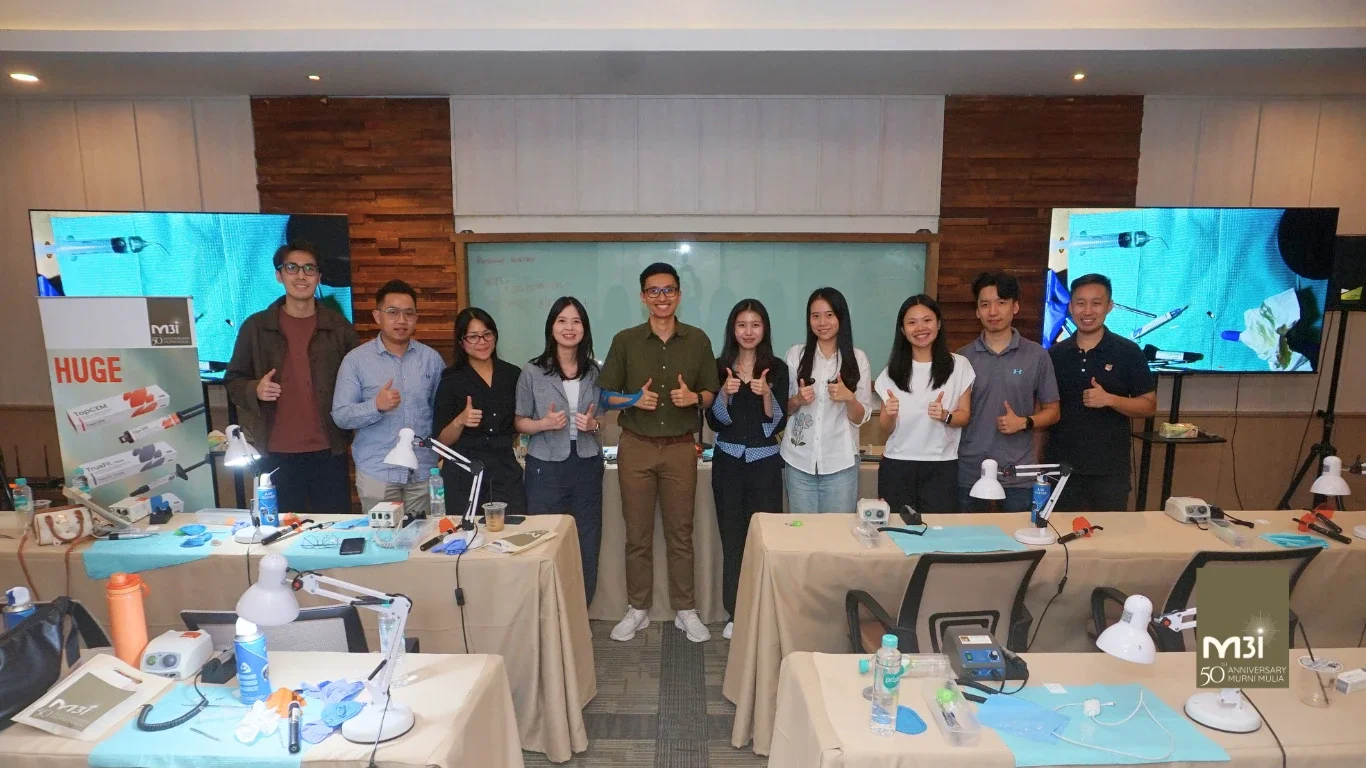
These real-life clinical situations became the focus of the One Day Hands-On Course: From Theory to Practice with drg. Eddy, PhD, held on Sunday, August 16, 2026, at the M3i Dentistry Development Centre.
From the morning, dental students and young dentists gathered to take part in a full day of learning.
And it was not simply about sitting and listening to lectures.
There were clinical cases to discuss, practical experiences to share, questions that participants may have encountered in practice, and opportunities to try several techniques directly through hands-on sessions.
It All Starts with How You Talk to the Patient
Before discussing clinical procedures, the session began with something that may seem simple but plays an important role in determining the next step: anamnesis.
How do you explore a patient’s complaint?
What questions should be asked?
And how can you make patients feel comfortable enough to openly explain what they are experiencing?
Through this session, participants were reminded that patient communication is more than just an opening conversation before an examination.
The information obtained during anamnesis can provide important initial clues before the dentist proceeds with further examinations and establishes a diagnosis.
From here, the discussion moved into more clinical topics.
When One Complaint Can Lead to Several Diagnoses
In everyday clinical practice, a patient’s complaint does not always point directly to a single diagnosis.
Pain, for example, still needs to be investigated further through anamnesis, clinical examination, and supporting examinations.
For this reason, one of the sessions focused on how to establish diagnoses for various cases commonly encountered in dental practice.
Participants were encouraged to see how information gathered from the beginning could be connected and used as the basis for identifying the patient’s condition and determining the next treatment plan.
The discussion felt highly relevant to everyday clinical practice.
These were not cases that existed only in textbooks, but situations that participants are likely to encounter—or may have already encountered—when treating patients.
Once a diagnosis begins to take shape, another question often follows.
What medication is needed?
Which drug is appropriate for the patient’s condition?
In the following session, participants received an overview of various medications and medicaments commonly used in dental practice.
The discussion served as a reminder that medication should not be selected simply because a particular product is commonly used.
The patient’s condition, indications, medical history, and treatment objectives must all remain important considerations.
The same principle applies when dentists choose materials for clinical procedures.
The availability of materials from a dental material supplier in Indonesia supports the needs of dental practices, but product selection should still be based on the indication and the procedure being performed.
Endodontic Treatment: Should It Be Feared?
One of the session titles that caught participants’ attention was:
“Endodontic Treatment – To Be Scared or Not?”
For some young dentists, endodontic treatment may be one of the more challenging procedures to perform.
Every case may present different conditions, and each stage requires careful attention, from diagnosis to treatment.
Through this session, participants were encouraged to approach endodontic treatment in a more systematic way.
Rather than seeing it as an intimidating procedure, they revisited the important points that need to be considered when managing endodontic cases in clinical practice.
But the day certainly did not stop with theory.
After several lecture sessions, it was time for participants to put what they had learned into practice.
During the hands-on session, participants worked directly with one technique that plays an important role in many dental procedures: rubber dam isolation.
This time, the practice focused on anterior teeth.
Participants not only observed how a rubber dam was placed, but also performed the procedure themselves.
From selecting the area to be isolated to positioning the rubber dam correctly, small details that may be difficult to understand through images or theory alone became much clearer when performed firsthand.
This was where the concept of From Theory to Practice truly came to life.
What had previously been discussed was now being performed with their own hands.
The Next Challenge: Class II Restoration
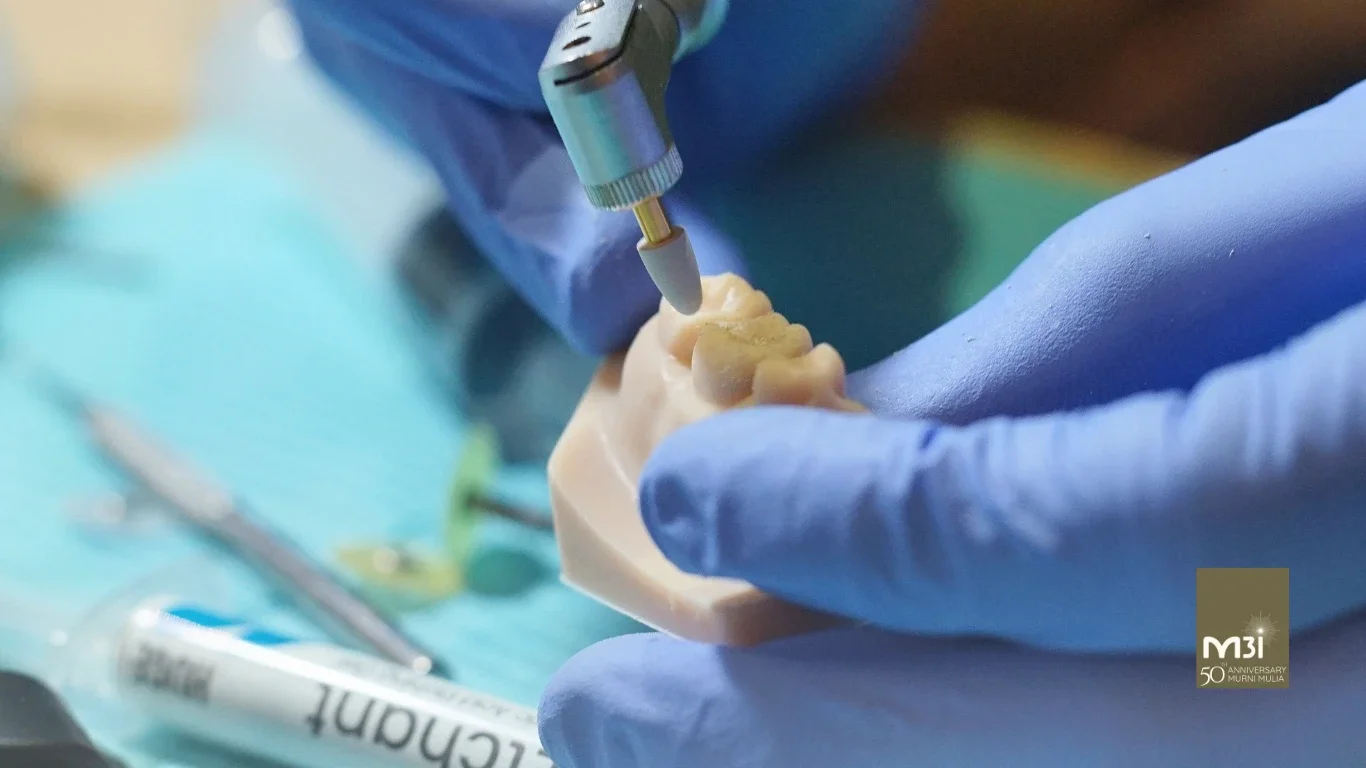
After the rubber dam session, the practical training continued with posterior filling techniques or Class II restoration.
Posterior restoration is not simply about placing restorative material into a cavity.
Dentists also need to consider the shape of the restoration, contact with adjacent teeth, and how the final result can restore proper dental function.
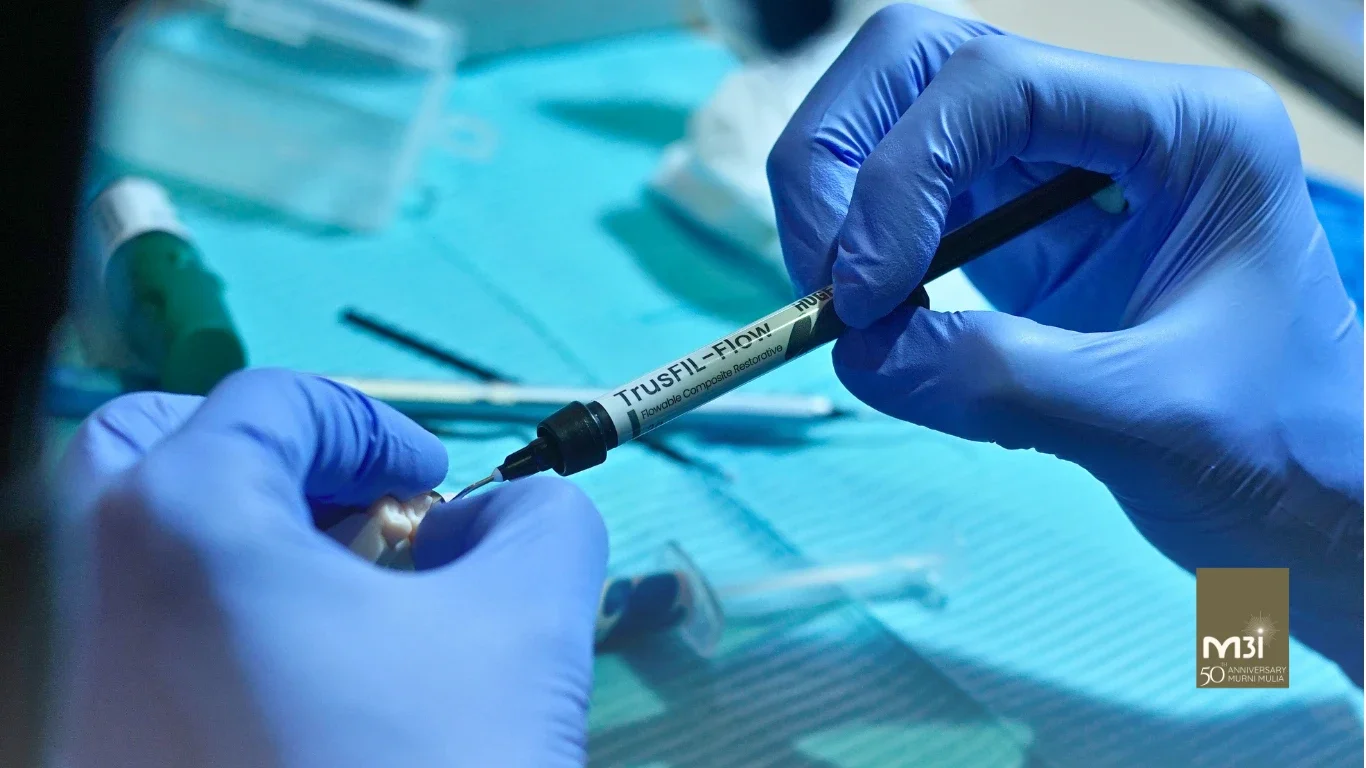
Participants had the opportunity to follow each stage of the restorative procedure through direct practice.
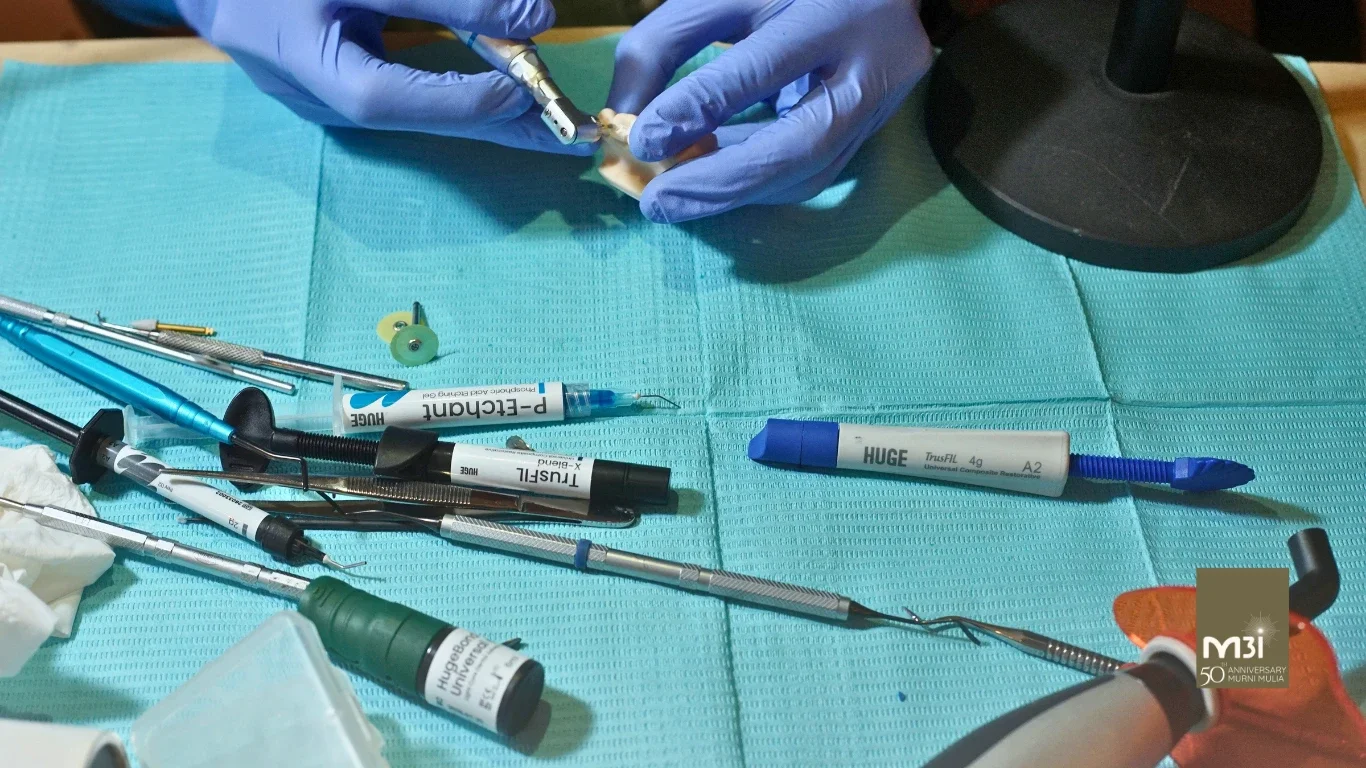
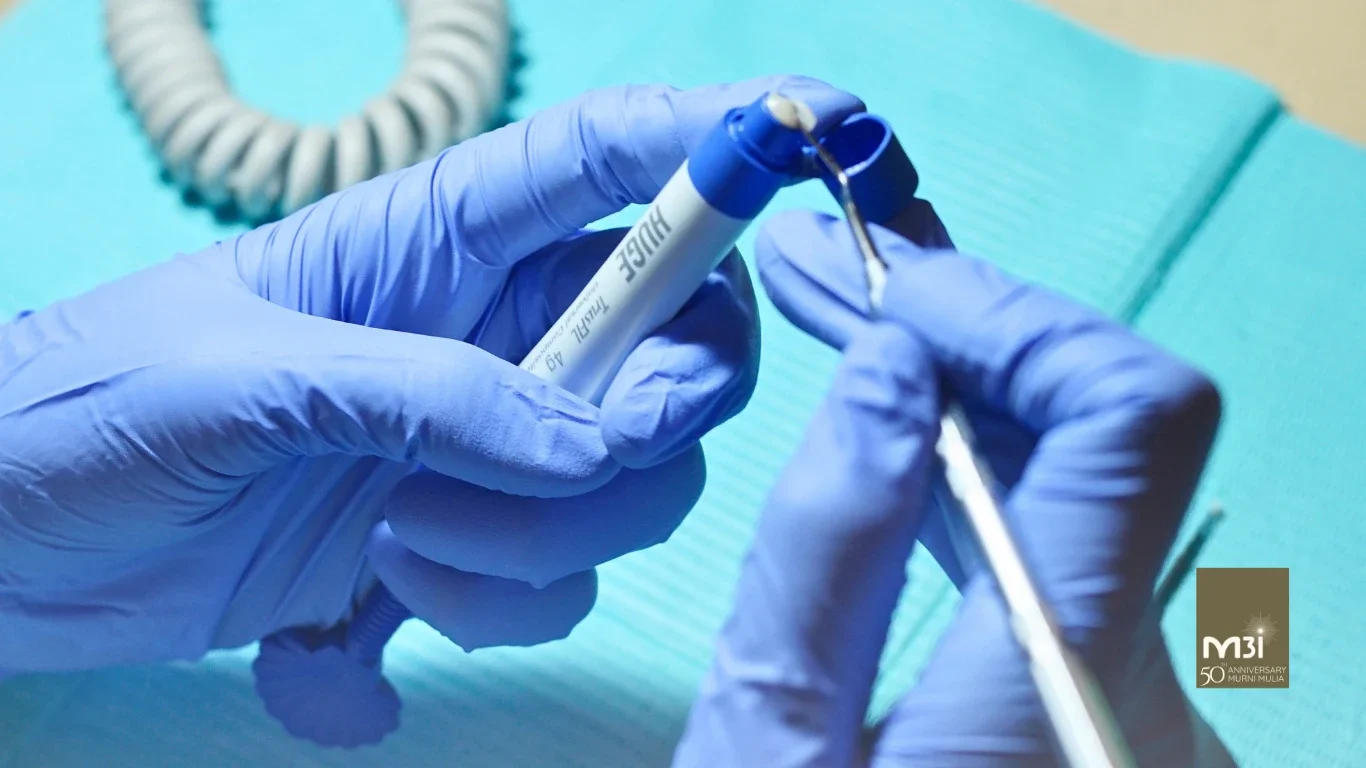
During this session, participants were also introduced to HUGE Trustfil Universal Composite, a restorative material from HUGE Dental.
HUGE Dental products are available through M3i Dental, which is also one of the HUGE Dental suppliers in Indonesia for various dental material needs.
Experiencing a material firsthand offers a different perspective compared with simply viewing it in a catalogue.
Participants could better understand the characteristics of the material as well as how it is used in the clinical procedure they were learning.
When Clinical Experience Enters the Discussion Room
Toward the end of the event, the learning atmosphere shifted into a discussion of cases commonly encountered in everyday dental practice.
This session was particularly interesting because clinical dentistry does not always provide one identical answer for every condition.
Many factors need to be considered before a dentist makes a decision.
A case that initially appears simple may become more complex when the patient’s condition is taken into account. On the other hand, a case that seems complicated at first may become easier to understand once all relevant information has been properly gathered.
Through discussion, participants were able to see how a clinical case can be analyzed from a broader perspective.
The questions no longer stopped at “What is the diagnosis?” but developed into “Why was this treatment chosen?” and “What needs to be considered before carrying it out?”
One Day That Brought Theory Closer to Clinical Practice
Before long, the series of activities that had started at 9:00 AM came to an end.
Over the course of one day, the discussion covered a wide range of topics.
It began with how to communicate with patients, take a proper history, establish a diagnosis, understand medications and medicaments, discuss endodontic treatment, perform rubber dam isolation, carry out Class II restorations, and analyze clinical cases together.
Everything returned to one shared objective: bringing theory closer to the situations dentists actually encounter in clinical practice.
As a dental equipment and material supplier in Indonesia, M3i Dental not only provides a wide range of products for dentists but also supports continuous learning through the M3i Dentistry Development Centre.
Programs such as seminars and hands-on courses provide opportunities for dental students and young dentists to meet, ask questions, practice techniques, and continue updating their knowledge.
Because in the end, learning dentistry does not always stop once the theory has been understood.
Sometimes, it is only when we begin putting that knowledge into practice that we discover how much more there is to learn.
